Why Deborah the Judge Would NOT Support Women in Church Leadership

This is a guest article written by my friend Michael White. It is in response to this

Deborah held the position of Judge in Israel at a time when there was no king in Israel and everyone did what was right in their own eyes (Judges 17:6). This is very similar to our politically correct pluralistic culture that we live in today in America.  We are often more concerned about pleasing the culture, and appearing fair in the cultures eyes, rather than honoring God or what His Word says (John 5:44, Gal 1:10). Israel had previously been delivered from the city of Hazor in Joshua’s time (Joshua 11:10), but the city had risen again (Judges 4) because of Israel’s disobedience. After the death of Ehud; Israel once again disobeyed until God raised up Deborah – a woman Judge. Continue reading
Posted in Christian Living, Guest Author | Tagged , , , , , , | 2 Comments

The Blessing and Curse of the Information Age

The internet gives a platform to anyone with an opinion. (This isn’t news.) There is no longer the filter of a publisher; money, or status isn’t necessary to be heard, and neither is coherence. While it’s tempting to bemoan this state of affairs, the better response is to realize the responsibility is now in your hands. The power is in your hands to literally find any side of any controversy, but that means you also carry the burden of filtering through the nonsense. It falls on you to recognize fallacy from logic, snake oil from cure, bias from fact. We can’t all be experts, scholars, and specialists, but we can all exercise tools of rationality to adjudicate between the testimony of various authorities on the ideas that matter. Don’t turn off your mind. Don’t let others think for you, and don’t let your desires numb your judgment.

The person armed with logic and humility toward the grace of God, is immune to both the chaos of information anarchy, and the tyranny of information totalitarianism.

Posted in Uncategorized | Leave a comment

Coming soon…

I have had a lot on my plate this last week, and the piece I was hoping to share this week isn’t quite ready. So, here’s a list of what I’ve been working on:

  • Starting an apologetics category
  • Reviewing a couple of books by Edward Feser
  • Starting a series on arguments for God’s existence by evaluating -from a layman’s perspective- Thomas Aquinas’s “First Way” and objections to it
  • Starting a series on eschatology by showing how a non-scholar (any ol’ Christian) can evaluate “controversial” topics like it
  • Sharing a lighthearted, and really silly, nerdy comic about Theological Hipsters

I tend to get pulled in several directions by my interests, and end up working on multiple projects in parallel, instead of cranking out one at a time. Don’t be afraid to comment or message me with your feedback!


Posted in Metapost | 1 Comment

Parables, Context, and the Prodigal Son

A quick examination of the famous parable, and why a couple of common interpretations just don’t fit the context.


Parables, analogies, and metaphors are as common as they are useful. They can communicate a concept far deeper than a simple description. We can know something much better when we can see it played out, feel its force, and watch it act. But they have limitations. A picture has a purpose: some central aspect of it is intended to communicate a truth. So, it’s important to determine the primary truth, and to not stretch it beyond its intent. Don’t take analogies too far, and don’t lose sight of the context.

Unfortunately, this is a common mistake in the study of Jesus’s parables. Let’s briefly examine one of the most famous parables, and see why a couple interpretations just don’t fit.  Continue reading

Posted in Bible Study, Uncategorized | Tagged , , , , , , , , , , , , , , | Leave a comment

The Application for Every Verse

Sermons and Bible studies tend to have a standard format: start with the scripture, end with the practical application. It seems a bible teacher is obligated to get through all the doctrine stuff fast, and get to the “meat,” the “point,” the important stuff: the ways it affects my life. Always looming over the teacher is the audience’s question: “why should I care?” Continue reading

Posted in Bible Study, Christian Living, It's all about Jesus, Uncategorized | Tagged , , , , , , | 4 Comments

Romans 9, 10, and 11 – Conclusion

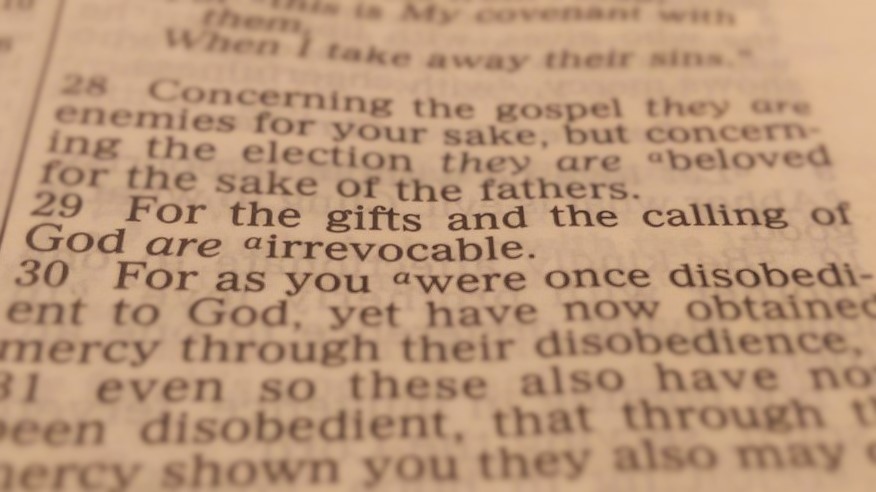
Gifts and Calling of God (3)This is the conclusion of our study of Paul’s answer to the question: How can we trust God’s promises to us, when Israel seems to be rejecting the gospel? Did God’s promise to them fail?


In Part 5, we saw the ultimate reason why God has not broken His promise to Israel: they will be restored. God caused them to stumble so that Gentiles can have unprecedented access to The Promise. God made a promise to Abraham that all the nations would be blessed in him, and that is fulfilled because they too can be saved by Christ. Gentiles benefit from Israel’s promise, and do so in large part because of Israel’s blindness to their own Messiah. Israel’s stumble is not for their ultimate doom, however. Some future day, Jesus the deliverer will take away their sin and restore them on a national scale. Continue reading

Posted in Bible Study | Tagged , , , , , , , , , , , | 2 Comments

Romans 9, 10, and 11 – Part 5

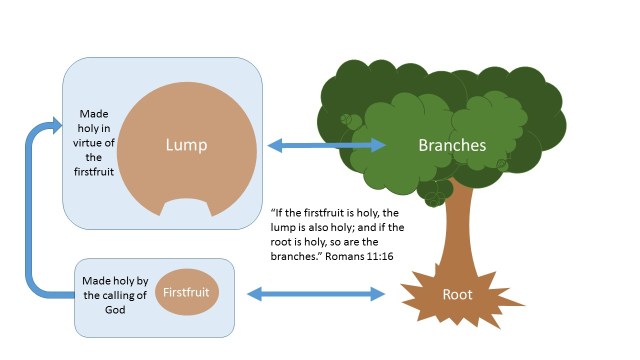
Romans 9-11 figuresWe are continuing our study of Paul’s answer to the question: How can we trust God’s promises to us, when Israel seems to be rejecting the gospel? Did God’s promise to them fail?

In Part 4, we saw that while Israel as a nation is set aside in God’s program, individual Jews still need the gospel (“there is no distinction between Jew and Greek [with respect to the gospel message] for the same Lord over all is rich to all who call upon Him). Also, God has not cast away Israel completely, because even now there are believing Israelites, including Paul himself: a remnant chosen by God’s grace (not because of works). Let’s now look at Paul’s final reason why God’s promise has not failed. Continue reading

Posted in Bible Study | Tagged , , , , , , , , | 3 Comments

Romans 9, 10, and 11 – Part 4

We are continuing our study of Paul’s answer to the question: How can we trust God’s promises to us, when Israel seems to be rejecting the gospel? Did God’s promise to them fail?


In Part 3, we saw that not only can Israel not trust in her lineage, but God is just in rejecting her and even hardening her for His glory. Israel is clay in the potter’s hands; the righteous God has the right to judge. We also saw the reason they are rejected (from the individual’s perspective): they did not seek righteousness by faith, but by works of self-righteousness. Paul will now show that the principle of faith was there all along, even in the very law that they used for self-righteous works. Continue reading

Posted in Bible Study | Tagged , , , , , , , , , | 4 Comments

Resurrection Resources

Happy resurrection Sunday! I thought I would share some resources around the web (or, youtube anyway) from Apologists and scholars, on the historical evidence for the resurrection of Jesus.

In the next few months, I hope to write (from a layman’s perspective) about the rational basis for Christianity, and a major piece, obviously, is the resurrection of Jesus. For now, I’ll just link to some sources! Continue reading

Posted in Christian Apologetics, History, It's all about Jesus, Off Topic | Tagged , , , , , | Leave a comment

Romans 9, 10, and 11 – Part 3

Romans 9:21

“‘O house of Israel, can I not do with you as this potter?’ says the Lord…” Jeremiah 18:6

“Does not the Potter have power over the clay?”

We are continuing our study of Paul’s answer to the question: How can we trust God’s promises to us, when Israel seems to be rejecting the gospel? Did God’s promise to them fail?


In Part 2, we saw that an Israelite cannot trust in his lineage to be in God’s people. Their privileged nation status was only by sovereign grace, and nothing special in them. God gives mercy to whom He wills; He is obligated to no one. Now Paul will continue to vindicate God in how He is using Israel for His glory and purpose.

Clay in the Potter’s Hands

9:17 For the Scripture says to the Pharaoh, “For this very purpose I have raised you up, that I may show My power in you, and that My name may be declared in all the earth.”
9:18 Therefore He has mercy on whom He wills, and whom He wills He hardens.

In verse 17, Paul selects an example that would be very familiar to Israel, and one unquestionably deserving of God’s judicial hardening. No Jew would question God’s righteousness in His dealings with Pharaoh, in using his evil heart to accomplish the divine plan. Continue reading

Posted in Bible Study | Tagged , , , , , , , , , | 3 Comments